Astronomy from the sidewalks of New York

Spotted via Bad Astronomy, this New York Times article:
While Times Square is not known for star gazing — the celestial kind, that is — and few people would normally venture onto a pitch-black ball field in Inwood to see the constellations, two unrelated, if not unlikely, projects hope to turn the city’s night eyes skyward.

Jason Kendall, an amateur astronomer, and Katja Aglert, a Swedish installation artist, want to turn out the lights in different parts of Manhattan and, weather permitting, illuminate the night sky.

“How can you appreciate something you’ve never seen?” said Mr. Kendall, 41. “You’ll never get anyone to make the sky dark until you show them how beautiful it can be.”
...

“Hey!” Mr. Kendall said. “You wanna see Saturn?”

Wsam tentatively peered through Mr. Kendall’s telescope.

“I don’t believe it!” he exclaimed. “Saturn really does have a ring.”


I did a double-take when I saw the name of the name of the amateur astronomer - Jason Kendall - someone I know from work! He worked for our department as a TA, even though he was working on a degree in Drama at the time (he already had a Master's in astronomy from another institution). He was always great to work with at the public viewing nights and he taught me how to find the Ring Nebula in under a minute just by star-hopping in the constellation Lyra (once you know what you're looking for, it's actually pretty easy to find). I'm not at all surprised to see him doing something like this.

This article also reminded me of my one attempt to see something naked-eye from the middle of Manhattan when I was there in 2006. Now granted, it was a very hot and humid night and I was standing outside Radio City Music Hall, but the only thing I could pick out was Jupiter.

I also highlighted the exchange from the end of the article because I've found that showing someone Saturn in a telescope for the first time will almost always bring the same reaction. And after the initial reaction you get the "it looks fake!" or "it looks like a picture!" comments. Or "you're just hanging something off the end of the telescope" - said in jest. I always laugh and assure people that they really are looking at Saturn. It will be interesting to see the reactions when we're looking at it later this year and there are almost no rings to see.

Picture of the Week #31


The Hobby-Ebery Telescope at McDonald Observatory. December 2003.

This photo was taken from the TQ (or Astronomers Lodge as it is now formally known) at sunset. I only learned just a couple of years ago that the pink line visible at sunrise/sunset is called The Belt of Venus, which I thought was a lovely poetic name.

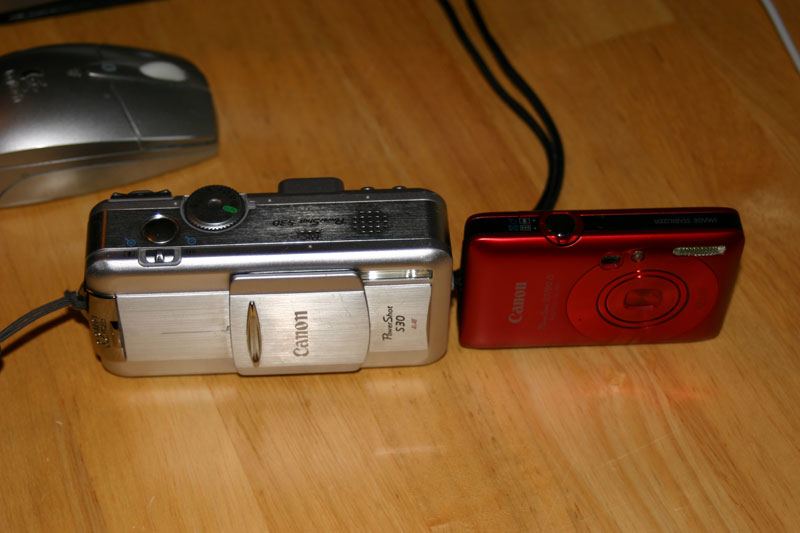
New camera!


A side-by-side comparison of my 2003 Canon point-and-shoot and my new 2009 Canon point-and-shoot (model SD780IS) that Dad bought me for my birthday (thank you again!). Finally I have a camera I can throw in my purse and not feel like I'm lugging around a lead weight!

We are Wizards

I've been hearing about We are Wizards (a documentary about Harry Potter fandom) for a while now and thanks to Hulu, I was finally able to watch it. And, if you're in the US, you can watch it too! I had two 'double-take' moments while watching it. The first was pretty early in the film when I realized that the footage from a live PotterCast they used was the one I attended! The second was while watching the segments with Brad Neely and I recognized that he was driving around my hometown of Austin, Texas. It's still a bit weird for me to see places or people I know on TV or in movies... which happens a lot more often than I would expect.

Picture of the Week #30


Gemini VII capsule at the National Air and Space Museum Steven F. Udvar-Hazy Center. September 2006.

From the information plaque:
Frank Borman and James A. Lovell Jr. lifted off aboard Gemini VII on December 4, 1965. Their primary mission was to show that humans could live in weightlessness for 14 days, an endurance record that stood until 1970. Their spacecraft also served as the target vehicle for Gemini VI-A, piloted by Walter M. Schirra Jr. and Thomas P. Stafford, who carried out the world's first space rendezvous on December 15. These two achievements were critical steps on the road to the Moon.

Picture of the Week #29


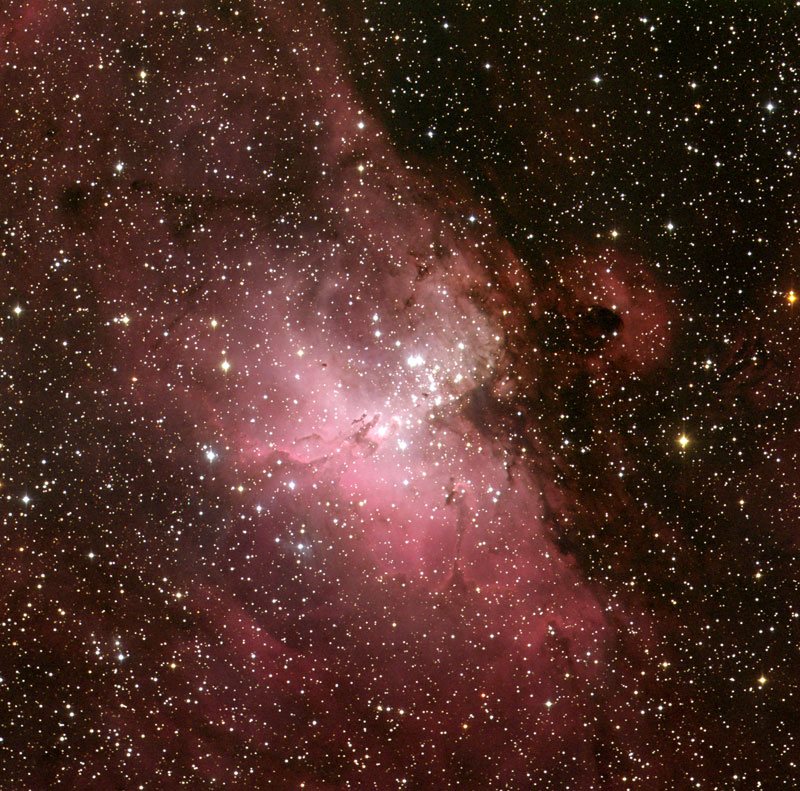
The Eagle Nebula (M16) taken with the Prime Focus Camera on the 30-inch telescope at McDonald Observatory in 1998 (AASTRA participants took the images and then I combined them into the final color image you see here).

Picture of the Week #27


The Austin Skeptics Society celebrated the 200th birthday of Charles Darwin last Thursday. The cake was courtesy of Taysia and the Darwin finger puppet is mine (from the Darwin exhibition at the American Museum of Natural History in NY in 2006).

Picture of the Week #26


Hall of Saurischian Dinosaurs, American Museum of Natural History, August 2006. T-Rex in foreground and Apatosaurus in the background.

I figured that some of the largest things to ever roam the planet was a good way to celebrate the 200th birthday of Charles Darwin, along with my favorite quote from On the Origin of Species (which was published 150 years ago this year):

... whilst this planet has gone cycling on according to the fixed law of gravity, from so simple a beginning endless forms most beautiful and most wonderful have been, and are being evolved."

Picture of the Week #25


Pluto, July 1997. 30-inch telescope at McDonald Observatory

This is a stack of 4 images taken over a 5 day period. If you look to the bottom of the frame, you will see 4 dots - red, green, blue and yellow, each representing Pluto on a different night. Three look regularly spaced with the red dot is further away. There would have been a spot between the red and green, but that night was cloudy, so no observation was made.


How the composite image was made:

If you look at the upper left and lower right corners, you will see two bright stars, which helped to find the field in each of the images. I took three of the frames and pulled them into Photoshop, each in a different channel. When the star images lined up, they appeared white, but the object that was different on each of the frames (Pluto), appeared as a red, green and blue dot from the object's image in each of the channels.

The fourth image was stacked (as a greyscale) over the combined image from above. The two images were added, and the fourth image of Pluto was hand-colored yellow.